


Understanding Slot Volatility: A Complete Guide to Risk and Rewards

Some slots seem to pay constantly, while others go quiet for long stretches before a big hit — that difference comes down to volatility. Volatility defines a game’s risk profile and payout distribution pattern. This metric measures how frequently a slot awards wins and the typical size of those payouts. A low variance game maintains steady action with frequent hits between 200 and 500 times the bet. High variance slots create longer dry spells without payouts, but compensate with prizes exceeding 100% returns when wins finally land. The volatility level shapes the entire rhythm of spins and directly affects bankroll requirements.
Slot volatility basics
Grasping the basics allows players to pick games that fit their budget and tastes since volatility indicates how risky a slot is and affects how winnings are spread throughout a gaming session. It connects how often you win with how much you get paid out; so, the more frequently a game pays out, the smaller those winnings usually are.
High volatility slots have stretches between wins, but they dish out much larger payouts when they do hit, while low volatility games give you frequent wins that help keep your balance steady. Medium volatility strikes a balance and mixes steady payouts with the possibility of occasional larger wins.
So, when there’s a lot of ups and downs, you need to be patient and have a bigger budget to ride out the quiet times. That’s why it’s smart to check the variance level before you launch any slot.
Slot volatility levels overview
Each volatility level defines distinct risk-reward parameters that determine how slots distribute payouts across spins. Understanding these differences helps you make informed decisions about which games to play.
| Volatility Level | Win Frequency | Average Payout Size | Potential Max Win |
|---|---|---|---|
| Low | Every 3-5 spins | 5-20x bet | 200-500x bet |
| Medium | Every 8-12 spins | 20-50x bet | 500-2,000x bet |
| High | Every 20-40 spins | 50-200x bet | 5,000-10,000x bet |
| Extreme | Every 60-100 spins | 200-1,000x bet | 20,000-50,000x bet |
| Insane | Every 150+ spins | 1,000x+ bet | 100,000x+ bet |
Low volatility slots
Low volatility slots are perfect for gamblers who like consistent play and a more controlled level of risk. They are easy to play, and their results are generally easy to predict. In these games, you often see reliable payouts that have a fairly steady balance as time goes by. When it comes to the biggest wins, they typically range from 200 to 500 times what you’ve bet.
As wins appear to happen more frequently, players can happily manage with smaller budgets and play extended gaming sessions. That is why a lot of players, especially those who are cautious or on a tight budget, tend to favor these slots.
Medium volatility slots
Medium volatility slots sit somewhere in the middle and suit those who want some action but don’t want to take on too much risk. They have ordinary wins and a few bigger payouts, so the gameplay feels livelier and more engaging. Moderate bet sizes typically work well here since dry spells don’t usually last long, and you can still snag some wins every now and then.
High and extreme volatility slots
These games present the most demanding challenge for players who seek substantial returns despite significant risks involved. They require careful bankroll management and strong discipline to handle extended losing streaks.
- Long dry spells dominate play sessions, and 50-100+ spins may regularly pass without any payout;
- Massive potential payouts reach 10,000x to 100,000x the bet amount when wins finally land;
- Bankroll swings create dramatic fluctuations that can deplete funds rapidly during cold streaks;
- Patience needed becomes essential as extended periods without wins test player’s resolve;
- Why players chase these games centers on the life-changing win potential that high-variance slots deliver through rare but enormous payouts.
Slot Examples by Volatility Level
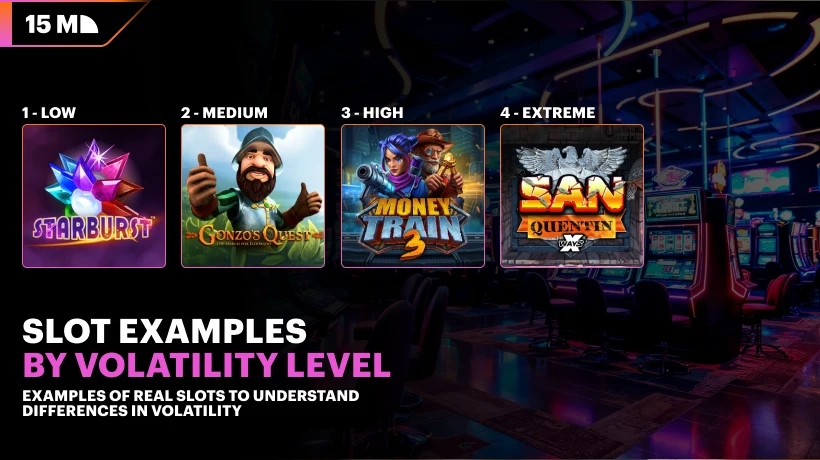
Different volatility levels are easier to understand when you see how they show up in real games. The same mechanics can feel completely different depending on how often wins land and how big they get.
| Volatility Level | Example Slots |
|---|---|
| Low | Starburst, Blood Suckers |
| Medium | Gonzo’s Quest, Book of Dead |
| High | Dead or Alive 2, Money Train 3 |
| Extreme | San Quentin xWays, Deadwood |
Volatility vs RTP vs Variance
Three key metrics shape slot behavior and define what players can expect. The comparison below breaks down how each factor operates independently, yet connects to form the complete picture.
| Term | Definition | Example |
|---|---|---|
| Volatility | A risk level that controls payout frequency and size | A high volatility means 50 dead spins, then a 200x hit |
| RTP | A long-term payback percentage paid to all players | 96% RTP returns $96 per $100 across millions of spins |
| Variance | The mathematical gap between the smallest and the largest possible wins | Low variance pays 2x to 50x while high variance spans 1x to 5000x |
Volatility vs Bonus Features Interaction
Volatility and bonus features go hand in hand, as most slots’ payouts typically come from their bonus rounds instead of the base game. In high volatility slots, bonus features usually hold most of the worth, so gamers might spend quite a bit of time in base gameplay before they hit the features that really determine how the session goes. In games with lower volatility, the base gameplay really steps up, as consistent wins help keep things balanced, while bonus features serve as rare lifts instead of being the main way to get returns. Cascades, multipliers, and expanding symbols can also heighten volatility because they change how wins come in, even if the overall RTP stays the same.
How Developers Design Volatility
Volatility in slot games doesn’t just happen randomly. It’s designed by developers using math models to determine how often wins happen and how those wins spread out during a session. Every slot is designed with a certain risk profile, shaped by various tweaks that affect how the game operates fundamentally.
In practice, developers manage volatility using a mix of core design tools, which include:
- Symbol weighting, which decides how often high-value and low-value symbols show up on the reels
- Reel engine setup, which influences how results are generated and how winning combinations come together
- Bonus trigger frequency, which determines how often feature rounds pop up during play
- Payout distribution rules, which outline how wins are shared between gameplay and bonus features
- Unique mechanics like cascades, multipliers, and expanding symbols, which add variance within spins
All these factors help studios adjust how “risky” or “steady” a slot feels, even if the RTP stays the same.
How to check a slot’s volatility
Most players can tell if a slot game is volatile or not by using simple methods that do not take a lot of work.
- Check the game information screen before you start playing;
- Open the paytable and look at the difference between big prize values;
- Read what the game provider says in the game description section;
- Try the slot game in demo mode for 50 to 100 spins to see how the payouts work;
- Visit websites that review slot games and list how volatile they are.
Bankroll tips for each volatility level

It’s important to adjust how you apply your bankroll strategies depending on the volatility level, so you can extend your playing time without running out of cash too soon. Even if you know you might lose a certain amount in a game type, planning your budget carefully helps you keep going.
- For games that don’t fluctuate much, it’s wise to set aside $50 to $100 and place bets of $0.20 to $0.50. This gives you about 200 to 300 spins for a session;
- For medium volatility games, aim to set your budget between $100 and $200, and stick with bets ranging from $0.50 to $1.00. That should get you roughly 150 to 250 spins;
- For high variance games, plan to budget $200 to $500 and place bets between $0.50 and $2.00. Thus, you will be able to play around 100 to 200 spins;
- When diving into high volatility games, it’s smart to set your bets at 1% of your total budget, which will help you play longer.
- Be ready to play low-variance slots for some time to yield wins. You may bump your bet size on a low volatility slot machine to about 2 to 3% of your budget.
Selecting the Correct Volatility Level
When looking for your preferred volatility choice, you want to answer the following questions guided by your preferences: what do you want to achieve, and what do you consider a risk for yourself?
- Low volatility means you want to play for a long time and have a chance to win small prizes frequently, without the risk of losing a bigger prize;
- Medium variance means you want to have a balanced approach so you can win moderate prizes and don’t want your money to run out too fast;
- High volatility means you are willing to take the risk and wait for a long time to win, and want to win a big prize, plus you are looking to win bonuses;
- Your risk tolerance should match your session goals. Don’t choose low volatility if you’re chasing big wins, and don’t pick high volatility if you want long, steady play — dry spells are part of that trade-off.
FAQ
Does RTP change with volatility?
RTP does not change with volatility. What changes is how the returns are distributed: high volatility games deliver larger but less frequent wins, while low volatility games spread smaller wins more evenly over time.
Which bankroll size is a constraint for low volatility?
Low variance is great for smaller bankrolls since getting frequent wins can stretch your playtime and lower the chances of running out of cash too fast.
If the game is volatile, is the potential for large wins greater?
The potential for large wins is greater for high volatility slots, but wins are obtained less frequently. In this case, the risk is that a player needs a great deal of patience and may need to have a significant bankroll to withstand more extended periods of losing before a win.

Have you enjoyed the article?