


Oklahoma Sweepstakes Felony Law Takes Effect, Naming Affiliates in Statute
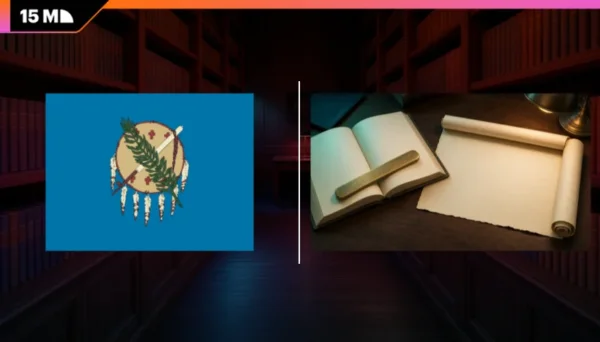
The Statute Expands From Two Roles to Seven
Senate Bill 1589 is a rewrite of 21 O.S. Section 941, a law that was originally passed in 1916. Title 21 originally only made it a crime to deal for gambling games if you were an owner or employee of the business. The enrolled version of Senate Bill 1589, filed on 14 May, also widens the verb. "Deals for" becomes "deals or provides support for".
The offence will not be limited to those operating dual-currency sweepstakes. It also extends to those providing the infrastructure and promotion: geolocation providers, gaming suppliers, platform providers, promoters and media affiliates. That verb change is a 15M reading of the two texts, comparing the pre-amendment Section 941 against the enrolled bill.
It should be noted that the bill does not specifically mention sweepstakes. A broader definition does the work instead. "Representative of value" now covers "any and all currency used as part of a dual-currency system of payment". The currency qualifies if it can be exchanged for money, prizes, or a chance to win either.
Penalties sit at Class C2. Class C2 crimes can be punished by a fine of $500 to $2,000, plus imprisonment under Section 20M, which sets a term of up to seven years in Department of Corrections custody. Offenders are required to serve at least 20% of their sentence before being eligible for release.
There are two exceptions to this law. The first is charitable gaming under the Oklahoma Charity Games Act. The second is tribal gaming on Indian lands, regulated under the Indian Gaming Regulatory Act. Notably, tribal gaming on Indian lands was not exempt under the original 1916 law.
The Governor Lost This One in May
After passing the Senate 48-0 on 2 March, and the House 65-21 on 4 May, Governor Kevin Stitt issued a veto on 7 May. His brief four-paragraph veto message warned of the reach of the law. "This bill is so broad that it criminalizes everyday apps people use for fun," wrote Governor Kevin Stitt. He added that it "unnecessarily creates a new felony".
Stitt’s veto was quickly overridden. The Senate voted 34-10 to override on 11 May and the House voted 68-19 on 14 May. The House was the chamber that hesitated both times.
No emergency clause was attached. That is why the effective date stayed at 1 November rather than May. Oklahoma is moving on this product through criminal law, not regulatory letters, unlike Michigan’s cease-and-desist route.
Source: Oklahoma Legislature, Enrolled Senate Bill 1589, https://www.oklegislature.gov/cf_pdf/2025-26%20enr/sb/SB1589%20enr.pdf

Have you enjoyed the news?