


#108 PFL Is Losing Its Own Name

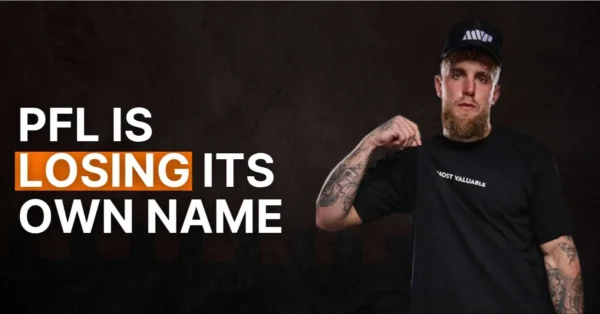
People laughed at me.
For years I’ve been citing YouTubers as case studies in serious meetings, and the reaction was the one you give a joke that didn’t land. I’ve watched MMA since Fedor, since Pride, since the era when nobody even called it an industry yet. So when Jake Paul turned up in combat sports, I didn’t see a circus. I saw the sharpest masterclass in distribution anyone has run in sport this decade. I said that out loud, to grown adults, in rooms where people take notes.
Last month the joke stopped being funny. MVP and PFL announced a merger, and the combined company keeps the name MVP.
Read that twice. PFL is seven years of operations, 34 broadcasters, 170 countries, a roster that includes Cyborg and Usman Nurmagomedov. MVP is a guy who was mostly making videos five years ago. Everyone was watching the fights. He was building distribution. Tyson on Netflix. Rousey on Netflix. An audience he didn’t have to rent from anyone. And PFL was doing everything right… Rights deals, regional broadcasters, athlete development, seven years of honest, disciplined operational work. That work just ended up inside someone else’s brand.
We’ve been doing the same thing for years and calling it business. Buying traffic from platforms we don’t own isn’t business. It’s renting, and the landlord can raise the price or change the locks whenever he likes.
What A Name Is Worth When You Don’t Own The Demand
Here’s the part worth sitting with. PFL didn’t lose the naming rights because its business is worse. By most operational measures, it’s the bigger, more serious company. It lost the name because operations and demand generation compound on completely different curves, and only one of them was ever going to decide what the sign above the door says.
Seven years of broadcaster relationships is real value, but it’s linear value. Every additional country, every additional deal, adds roughly what the last one added. An audience doesn’t work like that. It’s optionality. Once you’ve built people who show up because of you rather than because of the fixture list, you can point them at anything: a boxing card, a docuseries, a new promotion entirely. MVP wasn’t betting on fights being good. It was building a distribution asset flexible enough to be pointed at whatever came next, and PFL’s entire operational machine became one of the things it got pointed at.
That’s the uncomfortable translation for us. Rights, product, service-level agreements, licensing deals, market entries; this is all real, valuable, difficult work, and none of it compounds the way an owned audience does. It’s why an operator with immaculate execution and zero owned distribution is, structurally, a supplier to whoever does own the audience. You can do everything right for seven years and still end up as the fine print in someone else’s growth story.
The Landlord Problem, Except The Landlord Is A Platform
We already know renting traffic beats not showing up, and we already know owning distribution beats renting it. What’s less discussed is why the rent specifically punishes our industry, and it isn’t only about the price going up.
The channel you’re renting is the same channel your competitor is renting. Whatever edge you find in it (a creative angle, a bidding strategy, a placement nobody else has spotted) is visible to everyone else bidding for the same inventory, and it gets arbitraged away roughly as fast as you found it.
That’s not a platform problem, that’s an auction, and auctions don’t let you keep an edge, they just let you pay for one temporarily. Layer on the platform policy risk that comes with this industry specifically like creative knockbacks, account actions, ad rules that shift market by market and get decided somewhere you’ll never see, and renting is both expensive and structurally unstable in a way most other categories don’t have to live with.
None of this makes SEO, affiliates or paid media wrong. They’re still where most of the volume lives, and I’d never tell you to walk away from channels that work. But owned attention isn’t a fourth channel competing with the other three for budget. It’s leverage that changes the terms everyone else gives you, the affiliate that negotiates harder because you don’t need them exclusively, the ad account that matters less because it isn’t your only door in. Attention isn’t a layer on top of the asset. It is the asset. Everything else is bought.
Stephen Bartlett is running a cleaner version of the same play, in a different lane. His podcast isn’t advertising for his fund. It’s the reason his fund sees deals before anyone else does. Founders come to him because of the audience, and the audience is the sourcing engine. Swap “fund” for “book of business” and the question lands on our desks: what would an operator, a supplier, or an affiliate own if they built the equivalent instead of renting attention every single month?
PFL did everything a serious business is supposed to do, for seven years, and still ended up as a name that disappeared. If your entire growth engine still depends on channels you don’t own, whose name is actually going to be on the door when someone bigger decides they’d like your audience more than they’d like your operation?
Continue reading
Please enter your email to continue reading this content.
Have you enjoyed the post?