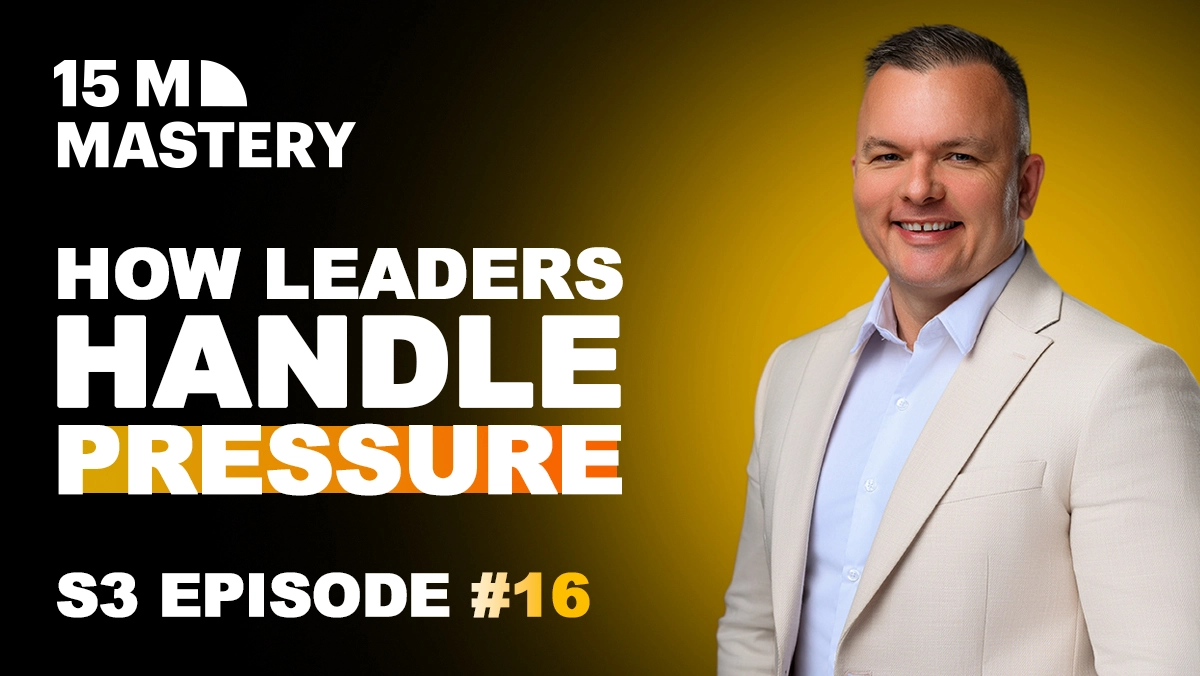
How Leaders Can Make Objective Decisions Under Pressure

The Weight of Command
A seasoned leadership coach recently highlighted a critical skill for those at the top: creating a "circuit breaker" between a triggering event and your response.
Leo Judkins, founder of iGaming Leader and a 17-year industry veteran, works with executives to navigate the immense pressure of high-stakes decision-making. He joined a webinar to deconstruct how leaders can maintain objectivity, manage their energy, and build the resilience needed to lead effectively without burning out.
From Reaction to Response
Under pressure, the default mode is often a reactive one, driven by emotion rather than perspective. The key to objectivity is creating intentional space between a trigger and a leader’s action.
“Very often when we instantly act on a trigger, we do things out of emotion,” Judkins explains. “We don’t really have a lot of perspective.” He contrasts reacting—which is often snappy and short-tempered—with responding, which is neutral, well-considered, and objective. He emphasizes that this is a skill to be developed over time, one that requires practice and an acceptance that perfection is not the goal.
Harnessing Pressure for Performance
The solution to hesitation is not less pressure, but a better understanding of its role. Judkins argues that pressure is not the enemy; it is an essential ingredient for high performance.
“Pressure creates performance,” he states. “Without pressure, you are bored and lethargic… When there’s too much pressure for too long, that is unmanaged… you burn out.” The challenge for leaders is to operate in the productive middle ground. For high-achievers who thrive under deadlines, the strategy is to break down large, daunting projects into manageable milestones and create external accountability, effectively engineering the right kind of pressure to spur action.
The Fallacy of the “Perfect” Decision
One of the most common and costly mistakes leaders make is believing they can, or must, find the single best solution entirely on their own.
“The most common mistake that leaders make in making decisions is that they’ve made the best possible decision,” Judkins asserts. He argues that great decisions require external challenge and perspective. “It doesn’t matter if you’ve got 20 years of gaming experience… your viewpoint is just yours.” He shares an example of a chief commercial officer who, after years of stagnation, repaired a broken CEO relationship and landed a new role within weeks of gaining outside perspective from a peer mastermind.
Managing the Energy, Not the Time
The emotional weight of leadership cannot be eliminated, but it can be managed. The paradigm shift, according to Judkins, is to focus on energy management rather than time management.
“It all starts with understanding that there’s a lot of emotional weight with running a business,” he says. “The key is managing your energy, not your time.” He notes that leaders are paid for the value they bring, not the hours they log. Common coping mechanisms like doom-scrolling Netflix or drinking to switch off are recognized as energy drains. Protecting one’s mental and physical energy becomes the foundational practice for sustained high performance.
A Path to Long-Term Resilience
Burnout is the result of unmanaged stress over a prolonged period. The antidote is a fundamental shift in self-expectation, moving from a binary to a graduated mindset.
Judkins introduces the concept of the “dial versus the switch.” “Very often high achievers are like people that are on a switch. It’s either 0% or it’s 100% and we expect 100% all the time.” This creates constant stress and a feeling of failure. The reframe is to see oneself as a dial. “Some days we only have 40% in ourselves… Sometimes your 40% is your 100%. And that’s okay.”
This self-compassion is vital for recovery. Judkins clarifies that prolonged pressure is inevitable; the problem isn’t the pressure itself, but a lack of compartmentalization and recovery. Building resilience is about taking control of how one responds to and recovers from stress.
Embracing the Fuel of Failure
Finally, Judkins challenges the industry’s risk-averse culture, arguing that failure is not something to be avoided at all costs, but a necessary component of growth.
“In gaming, we really don’t embrace failure at all,” he observes. But, like a baby learning to walk, we need failure to progress. “When we think about our own behavioral changes… it’s usually because of failures that we’ve had… Those are the big changes that we make that make us a far better human.” He concludes that avoiding failure stunts resilience and ensures stagnation. In a rapidly moving market, if you’re standing still, you are being left behind.
Have you enjoyed the post?
Persona