


Prediction Markets vs Sports Betting: Key Differences in Trading and Betting
At a quick look, prediction markets and sports betting seem pretty similar: you wager cash on a result and make a profit if you guess correctly. That similarity is often where most comparisons kick off and where things start to get tricky. Beneath the surface, these are actually two quite distinct systems. Sports betting relies on fixed odds set by bookmakers, whereas prediction markets function as peer-to-peer exchanges, with prices shifting based on up-to-the-minute demand. The way the mechanics work, the risks involved, and how profits are made all rely on totally distinct models.
Snapshot comparison of prediction markets and sports betting
Understanding the core differences between these two approaches helps clarify how each operates. The table below breaks down critical factors that separate prediction markets from traditional sports betting structures.
| Factor | Prediction Markets | Sports Betting |
|---|---|---|
| Opponent | Other participants in peer-to-peer contracts | Bookmaker or sportsbook operator |
| Price Setting | The crowd determines prices through live trading | Bookmaker calculates odds with a built-in margin |
| Revenue Source | Transaction fees on trade volume | Profit from the odds margin and customer losses |
| Return Calculation | Contracts settle at $0 or $1 based on the outcome | Fixed return based on pre-set odds at placement |
| Settlement Method | Binary resolution at event conclusion | Payout determined by initial odds accepted |
How prediction markets work: trading event contracts
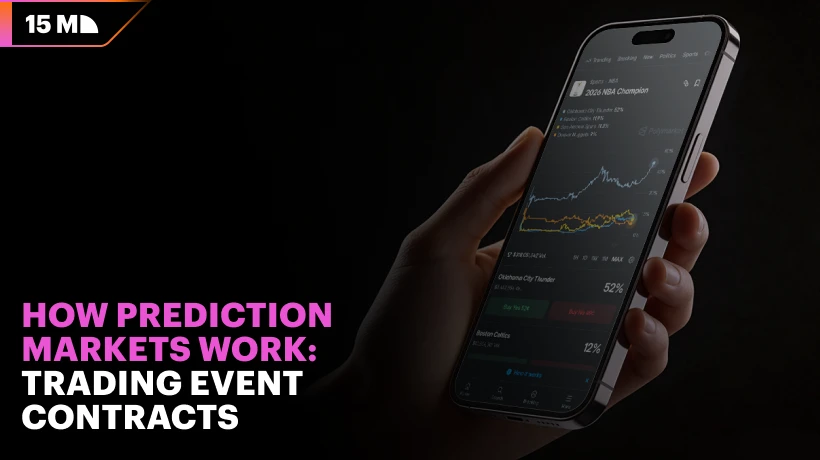
Prediction markets allow participants to buy and sell binary contracts that pay $1 if an outcome occurs or $0 if it doesn’t. The steps below outline how traders participate in prediction markets by purchasing and selling $1 binary contracts tied to specific outcomes.
- Fund your account with USD through bank transfer, debit card, or other accepted methods to establish buying power.
- Browse available markets across sports, politics, entertainment, and economic events to find contracts that match your prediction interests.
- Read the contract price as an implied probability — a $0.62 price indicates the market assigns a 62% chance to that outcome.
- Place a buy order if you believe the probability is higher than the current price, or place a sell order if you think it’s lower.
- Monitor price movements throughout the day as new information affects market sentiment and contract values shift.
- Close your position by taking the opposite side of your original trade before settlement, or hold until the event resolves at $0 or $1.
How sports betting works: taking lines
Sports betting connects bettors with bookmakers through a structured process that determines odds, locks in prices, and settles payouts based on event results. The following steps explain how participants place bets and collect returns.
- Review the odds displayed in American format (like -110 or +250) or decimal format (such as 2.50 or 1.91).
- Select your preferred betting market between sides (picking a team to win) or totals (predicting combined scores above or under a set number).
- Lock in your chosen odds at the displayed price before they change. Understand the vig, which is the bookmaker’s built-in profit margin, typically reflected in odds like -110 on both sides of a bet.
- Place your bet as a straight single selection or combine multiple picks into a parlay for higher potential returns.
- Wait for the event to conclude and receive your payout automatically if your selection wins, with the house calculating returns based on the locked-in odds.
Trading contracts vs taking lines: mechanics side by side
The operational mechanics of prediction markets and sports betting differ in four fundamental ways that shape how participants interact with outcomes and manage positions. These differences affect execution, pricing, flexibility, and profit calculation across both services.
| Mechanic | Prediction Markets | Sports Betting |
|---|---|---|
| Order execution | Peer-to-peer matching between buyers and sellers in real time | House posts fixed lines and accepts all incoming action |
| Price structure | Dynamic contract prices adjust continuously based on supply and demand | Fixed odds set by the bookmaker at the time of bet placement |
| Position flexibility | Traders exit positions anytime before settlement by selling contracts | Tickets are locked in until the event concludes, with no exit option |
| Profit calculation | Returns depend on the entry price versus the exit price movement | Payout determined by pre-set odds regardless of subsequent price changes |
What events can you trade or bet on today?
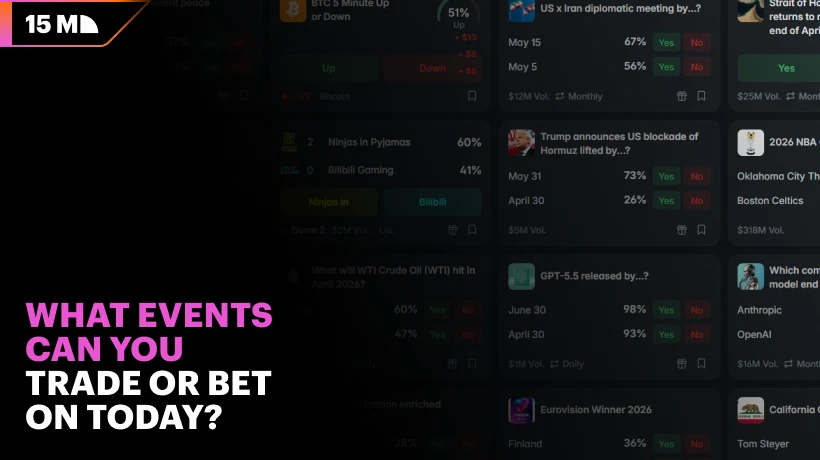
Both prediction markets and traditional sportsbooks now cover a wide range of outcomes in 2026, though each tends to specialize in different categories. Understanding where each service excels helps you choose the right venue for your forecasting interests.
- Major sports like the NFL, NBA, MLB, and soccer appear on both types of sites, though sportsbooks dedicate more markets to match outcomes and season-long futures;
- Player props, including touchdown scorers, rebounds, and strikeouts, remain more common on sportsbooks than prediction markets;
- Political contests such as presidential elections, congressional races, and legislative votes appear primarily on prediction markets due to regulatory structure;
- Economic data releases covering Federal Reserve decisions, employment reports, and inflation numbers exist almost exclusively on prediction markets;
- Entertainment awards, including Oscars, Grammys, and Emmys, show up on both, with prediction markets offering more variety;
- Pop culture specials such as celebrity announcements, viral moments, and social media milestones appear more frequently on prediction markets.
Pricing and Formulating Probabilities in Multiple Formats
Learning how pricing corresponds to probabilities, and you will be empowered to analyze and evaluate value for numerous formats. It enables you to take advantage of any opportunities in the market that arise when breaking news occurs. Prediction market contracts and sportsbooks do respond to the same information, but they do show probabilities in different formats.
- Look at the price for a contract in the prediction market and read it as a percentage directly. For example, a contract that is worth $0.68 has a 68% implied probability.
- In order to make the conversion from a sportsbook price to a probability, use the relevant conversion method. With American odds, the method involves taking the stake and dividing it by the total return to get the true percentage at risk.
- Remove the margin from the sportsbook odds to reveal the house edge. Most books are going to embed 4-8% profit into their lines.
- When injury reports or poll results are made available, monitor both formats as the prices will reflect the new information almost instantaneously.
After translating both formats into similar probabilities, you can figure out the value. Check out prediction market prices alongside sportsbook-implied probabilities to find any discrepancies, and find out if a position presents a positive expected return when weighing the payout against the likelihood.
How Operators Profit: Edge & Incentives
The revenue structures for both models shape distinct behaviors for sharp bettors and traders who seek an edge.
Prediction Markets: Volume-Driven Model and Trader Incentives
Prediction markets make money based on how much trading happens, not from users losing bets. Operators make money from transaction fees on every trade, no matter if users win or lose, so their profits depend on how active the market is.
User successes actually back this model. When there’s more liquidity and traders are more active, the market tends to be both efficient and appealing, leading to a rise in trading volume and profits for operators.
Traders in prediction markets pay attention to discrepancies in prices. They’re continuously trading contracts to make the most of changing odds and mispricing.
Sportsbooks: Margin-Based Model and Bettor Constraints
Sportsbooks pull in money mostly from bets that don’t win. When bettors lose, the bookmaker pockets the stake, and even when bets win, they’re countered by the margin in the odds.
User success actually goes against what the operator wants. Winners cut into sportsbooks’ profits, so bookmakers tweak their odds, manage risk, and sometimes put limits on accounts.
Basic strategies for prediction market traders
There are some standard strategies that contract traders are able to use to avoid losses due to market impulse. Most of the following strategies help participants mitigate their exposure to potential losses and maximize profits.
- Make sure that you trade in the most liquid markets. Trading in the most liquid markets gives the trader the most freedom to make the most movement in a contract with the least potential for losing their investment to a large shift in the market;
- Use limit orders instead of market orders. Market orders are more likely to find themselves in a position where they have to sell at a volatile price;
- Take quick profits. If a contract shift moves in the desired direction (2-3 triangles), you should be able to sell the contract and make a living off the quick price change;
- Make sure that you trade quickly. If you hear about new polls or new information that supports injury or trade rumors or new important information, you must act quickly. If you hear of important information that may shift a probability, contemplate the new information, and the prices will adjust;
- Make sure that you sell or make a contract trade at the right market price and avoid the risk that the new information (price) creates.
Basic strategies for sports bettors taking lines

Giving some thought to disciplined strategies regarding value, risk, and market awareness can help sports bettors improve their results and mitigate losses:
- Always look for the best lines before placing a bet;
- The line you bet on compared to the closing line shows your long-term profitability potential, so track your closing line value;
- Gain an edge over the oddsmakers by establishing superior knowledge of the markets in 2 to 3 specific leagues or prop categories;
- Record your bets, starting with date, odds, stake, and result, to analyze your betting weaknesses and strengths;
- Bankroll management is important, especially during a losing streak. Control your bet size to 1 to 3% of your total bankroll to withstand losses;
- The variance risk of long-shot parlay bets is extreme. Understand the compounded house edge of such bets before placing them.
Pros and cons of prediction markets and sportsbooks
Both models have unique advantages and disadvantages. The table below delineates a number of key elements so you can better grasp which model fulfills various requirements and preferences.
| Aspect | Prediction Markets | Sportsbooks |
|---|---|---|
| Flexibility | Exit positions anytime before settlement | Fixed bet until event conclusion |
| Clarity of probabilities | Direct percentage display ($0.62 means 62%) | Requires odds conversion to understand probability |
| Ease of use | Steeper learning curve for contract trading | Familiar bet slip mechanics for most users |
| Volatility | High price swings create trading opportunities | Stable lines with minor adjustments |
| Potential edge for skilled users | Profit from market timing and information analysis | Edge is limited by bookmaker margins |
| Familiarity for casual players | Less intuitive binary contract structure | Standard odds format is recognized globally |
Which format suits you?
Depending on the format and objectives, users may find the prediction markets, traditional sportsbooks, or a combination of both to be the value proposition. Below is the user profile mapping to the format most suited to them.
- Data-driven professional traders: We categorize them under prediction markets, as prices are a representation of probability percentages and advanced contractual agreements, there is an option to exit before settlement;
- Sports fans: Sportsbooks tend to be a better fit as the fans have familiarity with the odds format, which requires scant monitoring;
- Action-driven users: All formats are suitable, as prediction markets have dynamic pricing, and there is instant gratification from sportsbooks;
- Long-term contract forecasters: Sports prediction is optimum and parading;
- Hedge-seeking users: prediction markets and sportsbooks serve them as they allow arbitrage and the ability to parlay on multiple outcomes across sportsbook events.
FAQ
How is trading contracts different from betting on sportsbook lines?
Trading contracts allows you to freely trade peer-to-peer on variable $1 share contracts that are priced in real-time, while taking lines is trading on fixed prices (odds) determined by a sportsbook, which are locked in and remain until a bet is settled.
Can a user easily move between different prediction markets and various sports betting formats?
Moving between different prediction markets and sports betting formats tends to be simple in theory, but in practice, each has its own unique definitions, risk profiles, and styles of managing your bankroll. To better learn the mechanics of each format, users are advised to start with smaller bets in different markets.
Are prediction markets more profitable generally than sportsbooks?
From a return potential standpoint, prediction markets and sportsbooks are on a level playing field. Users must practice good risk management and pricing discipline, as well as be adept at identifying edges, in order to be profitable. Prediction markets can be more profitable than sportsbooks because of the trading skills required to be able to execute contract flips.
How reliable is pricing in prediction markets?
Prices in prediction markets show the current odds based on what users are doing together. In fluid markets, this can be pretty spot on, but prices still get influenced by speculation and can really change based on what people are feeling. So, they ought to serve as a reference, not a foolproof way to predict results.
Is liquidity important when it comes to choosing a market to trade on or place a bet?
There is a relationship between liquidity and pricing in prediction markets. Similarly, with sports betting, liquidity allows the user to place a greater maximum stake on a particular betting line before the bookmaker limits the account of the user or moves the betting line from its current value to negate the advantage of the bettor.