


Sports Betting Odds: Complete Guide to Reading Lines and Calculating Payouts
Sports betting odds show the probability of an outcome and the size of a potential payout, yet many players struggle to interpret them correctly. Three main formats exist worldwide: American odds use plus/minus symbols, decimal odds multiply your stake directly, and fractional lines display profit ratios. All three formats represent the same probability but present it differently. This guide explains how bookmakers set lines, what the numbers mean for your bankroll, and how to calculate returns across moneylines, spreads, and totals in global betting markets.
Sports betting odds basics
To understand betting odds, you need to know what they mean. Odds show both how likely an event is to happen and how much money you could win if you bet on it.
They are based on implied probability, which means that each line shows how likely a bookmaker thinks a certain outcome is. This probability is directly related to payouts: outcomes that are less likely to happen have higher potential returns, while outcomes that are more likely to happen have lower potential returns.
At the same time, odds are not set in stone just by chance. Bookmakers change them based on how the sports market is doing and keep a margin while balancing bets on both sides. Even though different formats show odds in different ways, the basic link between risk, probability, and payout is the same in all betting markets.
How bookmakers build margins into odds
Betting odds do not reflect the pure chance of some outcome. Bookmakers include a margin, often called the “overround,” in every sports market to ensure long-term profits. This means the total implied probability of all possible outcomes usually exceeds 100%.
This built-in margin lowers the actual value of every line. As a result, even accurate predictions can yield less than expected. Bettors can see the impact more clearly if they compare bookmakers. Small differences in odds between sportsbooks can greatly influence long-term returns, particularly in high-volume betting.
Main odds formats worldwide
Odds vary by region, and today, three main formats dominate global markets. Here are the main ones:
| Format Name | Typical Regions | Basic Meaning | Simple Win Example |
|---|---|---|---|
| American | USA, Canada | Plus shows profit on a $100 bet, minus shows the stake needed to win $100 | +200 means a $100 bet wins $200 profit |
| Decimal | Europe, Australia, Canada | The number shows the total return per $1 staked | 3.00 means a $1 bet returns $3 total |
| Fractional | UK, Ireland | The ratio shows profit to stake | 5/1 means a $1 bet wins $5 profit |
How American odds work
In the United States, American odds, also called moneyline odds, are very common. They show both the chance of winning and the possible returns using a simple plus/minus system.
A minus sign (−) shows the favorite and tells the bettor how much they need to bet to win $100. A plus sign (+) shows the underdog and tells you how much money you can make by betting $100.
For instance, odds of −150 mean that a person who bets $150 has to risk $150 to win $100, while odds of +200 mean that a person who bets $100 receives $200. The original stake is included in the total payout in both cases.
Even though the format looks different from decimal or fractional odds, it is based on the same idea: higher risk means lower probability, and returns that are more likely to happen come with lower risks.
To calculate your returns, use these formulas:
- Profit (positive odds): Profit = Stake × (Odds / 100);
- Profit (negative odds): Profit = Stake × (100 / Odds).
How decimal odds translate into returns
Decimal odds are widely used across European and international markets because they present payouts in a direct, linear format. The number shown already includes the full return.
To calculate results using decimal odds:
- Take the decimal value listed next to the selection.
- Multiply your stake by that number to determine the total payout.
- Deduct the original stake to isolate the net profit.
For instance, odds of 2.50 turn a $100 bet into $250 in total returns, which includes $150 in profit. Similarly, a $50 bet at 1.75 produces $87.50 overall.
In this format, larger numbers correspond to lower-probability outcomes with higher returns, while values closer to 1.00 signal stronger favorites and more limited upside.
How fractional odds show profit ratios
Fractional odds, still common in UK and Irish betting markets, present returns as a ratio between profit and stake. This format focuses on how much can be won relative to the amount risked.
To interpret and calculate fractional odds:
- Read the fraction as profit in relation to stake, so 5/1 represents $5 won for every $1 at stake.
- Convert the ratio into a multiplier by dividing the first number by the second.
- Apply that multiplier to your stake to determine profit, then add the original stake to calculate the total return.
For example, a $10 bet at 5/1 generates $50 in profit and $60 in total payout. By contrast, shorter odds such as 1/2 indicate that the potential return is smaller than the stake, marking a higher-probability outcome.
Although the presentation differs, fractional odds follow the same underlying logic as other formats, linking higher rewards to less likely results.
Comparing odds formats side by side
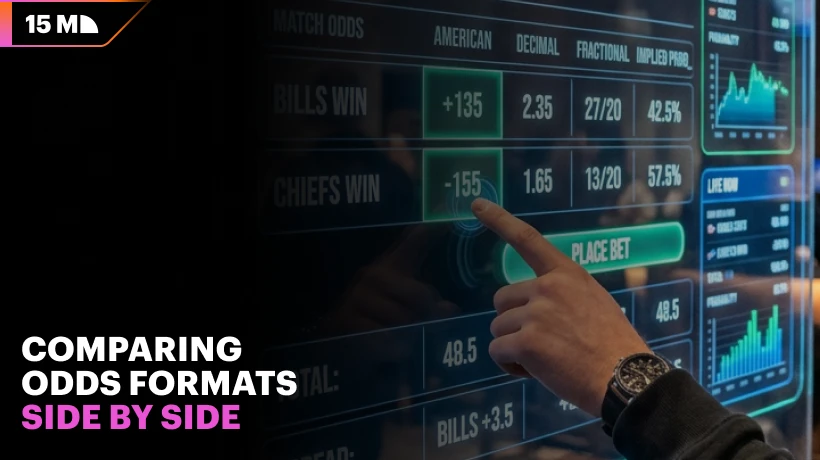
Betting odds make more sense when you compare all three formats side by side. Each system shows the same probabilities, even though bookmakers use different ways to present them.
| American Odds | Decimal Odds | Fractional Odds | Probability |
|---|---|---|---|
| +200 | 3.00 | 2/1 | 33.3% |
| -150 | 1.67 | 4/6 | 60.0% |
| +350 | 4.50 | 7/2 | 22.2% |
| -200 | 1.50 | 1/2 | 66.7% |
Where odds are used: main betting markets
The type of sports market tells a bettor what outcome they are betting on, but the odds for all bets are the same. Most sportsbooks focus on three main sports markets, and each one has a different way of framing the bet.
| Market Type | What Bettor Predicts | How Odds Usually Look | Short Example Line |
|---|---|---|---|
| Moneyline | Which team wins the game outright | Plus or minus signs with numbers | Lakers -180 / Celtics +155 |
| Point Spread | Whether a team wins by a set margin or keeps the score within it | Point value combined with odds | Cowboys -7.5 (-110) |
| Totals (Over/Under) | Whether the combined score is above or below a set number | “Over” or “Under” with total points | Over 215.5 (-105) / Under 215.5 (-115) |
Examples of reading a betting line
To understand how sports betting lines work, you need to look at examples from different sports. These show how lines turn into dollar amounts.
- NFL spread: Patriots -7 (-110). You bet $110 to win $100 if New England wins by 8 points or more;
- Soccer moneyline: Arsenal 2.85. A $100 bet returns $285 total ($185 profit) if Arsenal wins;
- NBA total: Over 215.5 (-110). You bet $110 to win $100 if the combined score reaches at least 216 points;
- MLB moneyline: Yankees 7/5. A $100 bet returns $140 profit if New York wins.
Parlays, teasers, and accumulators odds
When you combine several bets on one betslip, the way odds work changes. This also shifts the potential returns in betting markets.
- Start with the odds for every selection you plan to include.
- Multiply these lines together. You get your payout as a decimal number.
- To convert American lines to decimal, divide the positive lines by 100 and add 1.
- Then, multiply the lines by your stake. This shows how much you could get back in total. Adding more legs increases the risk each time.
Live betting odds and line movement
Unlike pre-match lines, live betting odds shift on a second-by-second basis as events unfold in real-time. These changes capture pivotal events like goals, touchdowns, turnovers, or how much time is left, as well as external forces like injuries and red cards that can quickly change the calculus. This process is called line movement, which is the changes in odds from when they first open until now.
The sports market activity can play a part (and often does); if one side receives too much action, bookmakers may pull the line to balance their exposure. For sports bettors, keeping tabs on these movements is crucial as swift changes in betting prices can show potential value.
Common mistakes when reading odds

When you’re starting to learn betting odds and placing your first bets, there are some mistakes you should avoid.
- Beginners often get confused by plus and minus signs. Some think the plus sign means a team is the favorite, but it actually marks an underdog;
- Many bettors look only at profit. They overlook implied probability, which tells you how likely an outcome is based on the lines;
- Parlay bets cause trouble for some. When you mix several bets into one parlay, each pick makes it harder to win overall;
- It’s easy to calculate profit alone and forget about stake return. Total payout includes your stake as well as any winnings;
- Different lines formats can cause confusion if you don’t convert them correctly. Trying to compare these without conversion often leads to errors in judgment.
Quick odds conversion shortcuts
Now that you have learned the core odds formats and how to do the calculations, use these simple shortcuts to switch between formats and calculate probability more quickly. These conversions are never going to be exact remakes of full calculations, but they allow for a quick take on betting lines as they happen in real time.
| Format | Example | Conversion Shortcut | Implied Probability |
|---|---|---|---|
| American Positive | +200 | Divide by 100, then add 1 for the decimal | 33% |
| American Negative | -150 | Divide the lines by 100 for a profit ratio | 60% |
| Decimal | 3.00 | Subtract 1, then multiply by 100 for American | 33% |
FAQ
What does +200 mean in sports betting odds?
A +200 line means the pick is an underdog. If you bet $100, you can win $200 in profit.
How do negative odds work in moneyline betting?
Negative lines show which side is the favorite. They tell you how much money you need to bet to win $100. For example, -150 means you have to risk $150 to make a profit of $100.
Which odds format is easiest for beginners?
Decimal odds are for new bettors. Multiply your stake by the decimal to get total returns. Fractional odds need you to divide numbers. American odds use plus and minus signs, so you have to do some math in your head.
How do betting odds relate to probability?
You can use formulas to turn any line format into an implied probability percentage. This shows the chance that bookmakers give for an outcome.
Can odds change after placing a bet?
Your odds lock in when you confirm. After you place a bet, the lines do not change.